

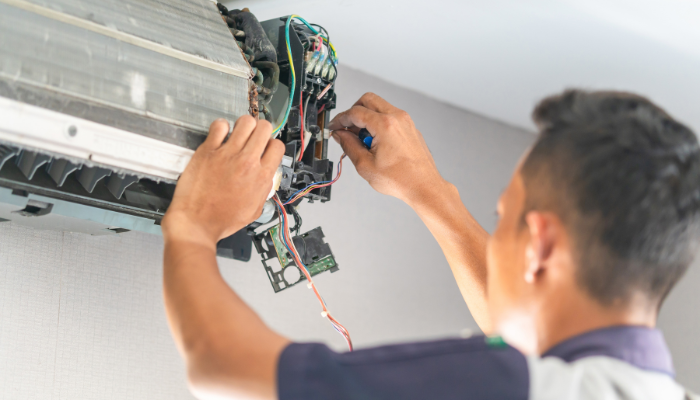
Most air conditioner repairs in Australia cost between $150 and $600, with the median job landing around $190. Simple fixes like a new capacitor or a blocked drain can start near $80, while a major fault such as a failed compressor or a serious refrigerant leak can run past $1,000. At QuickAir, we have diagnosed and repaired heating and cooling in more than 20,000 Australian homes, and what a repair actually costs almost always comes down to three things: the part that has failed, the type of system you have, and whether you are being charged a separate call-out fee on top.
The wide range catches people out. A homeowner whose split system has simply lost its remote settings is in a very different position to one whose ducted unit has a dead compressor, even though both start with the same phone call. Below is the full picture: the typical cost by fault, how your system type changes the number, what call-out fees and labour actually add up to, and how to tell when a repair is no longer worth paying for.
Average air conditioner repair costs at a glance
Here is what the numbers look like across the industry before we break them down. These figures are drawn from national tradie pricing guides and match what we see day to day.
- Median repair: around $190
- Typical range for most jobs: $150 to $600
- Simple fixes (capacitor, thermostat, filter, drain clear): $80 to $250
- Major faults (compressor, serious refrigerant leak, control board): $500 to $2,000 or more
- Labour: $80 to $150 per hour for a qualified technician
- Call-out or diagnostic fee: $80 to $150 at many providers, often charged even if no repair goes ahead
That last point is where a lot of the uncertainty lives, so it is worth understanding before you book anything.
Aircon repair cost by type of fault
The single biggest driver of price is which component has failed. A worn part that a technician carries on the van is a quick, cheap fix. A sealed-system fault or a major electrical component is a bigger job. The table below shows typical all-in costs, including parts and labour, for the repairs Australian homeowners ask us about most.
| Repair | Typical cost range (parts and labour, AUD) |
| Air filter replacement | $70 to $105 |
| Minor service or tune-up | $70 to $195 |
| Capacitor replacement | $95 to $250 |
| Thermostat or controller replacement | $108 to $250 |
| Refrigerant regas or recharge | $160 to $400 |
| Refrigerant leak repair | $165 to $400 |
| Circuit or control board replacement | $120 to $600 |
| Fan or blower motor replacement | $295 to $900 |
| Compressor or major component | $500 to $2,000 or more |
Treat these as ranges, not fixed quotes. Two homes with the same fault can land at different prices once the brand, the part cost, and the labour time are factored in. As a rule, anything to do with refrigerant or the compressor sits at the top end, because the parts cost more and the work has to be done by a technician licensed to handle refrigerant. Swapping a capacitor or clearing a drain sits at the bottom.
How system type affects repair cost
The kind of system you have changes the labour and service cost, separate from the parts. A single wall-mounted split is quick to reach and diagnose. A ducted system running through the roof, or a multi-head setup with several indoor units, takes longer to work on and often costs more before a single part is replaced. The table below shows the typical service and labour cost by system type, which sits on top of any parts the repair needs.
| System type | Typical service and labour cost (AUD) |
| Ducted system | $70 to $135 |
| Split system | $80 to $160 |
| Gas heater | $90 to $180 |
| Inverter unit | $95 to $190 |
| Multi-split system | $115 to $225 |
| Ducted VRV or VRF system | $140 to $250 |
The pattern is straightforward: the more complex the system, the more it costs to work on. A split system is usually the cheapest to repair, while ducted reverse cycle and multi-head systems cost more because there is more to diagnose and reach.
Call-out fees, labour rates, and after-hours charges
Beyond the repair itself, how a company charges makes a real difference to the final bill. Most operators bill labour by the hour, at $80 to $150 for a qualified technician, and many add a call-out or diagnostic fee of $80 to $150 on top just to attend and look at the unit. That fee is often charged whether or not any repair goes ahead.
Timing matters too. An urgent, after-hours, or weekend visit usually attracts a premium, and some operators charge close to double their standard rate for an emergency call-out. On the hottest day of summer, when demand spikes and you need someone fast, that is exactly when those premiums land.
This is the part of the bill homeowners fear most, because the phone quote and the final invoice do not always match. Through our work at QuickAir, one approach we have found removes that uncertainty entirely: a single fixed price, known before the technician leaves the depot. A breakdown and repair assessment is a flat $259, or $249 if you have booked with us before, and that covers the call-out and the full on-site diagnosis. There are no separate call-out fees, no per-minute charges, and no weekend surcharge. If the fault can be fixed on the spot with a part we carry, it is often sorted there and then. Anything more involved is quoted in writing and approved by you first. The price you see is the price you pay.
What affects the cost of an air conditioner repair
Even within the ranges above, a few factors push your final number up or down. Knowing them helps you read a quote and understand why two jobs that sound similar can be priced differently.
- The part that failed. A capacitor or a controller is cheap and quick. A compressor, a circuit board, or a sealed refrigerant leak is a bigger job with pricier parts.
- Brand and parts availability. Common brands like Daikin, Mitsubishi and Fujitsu have parts on the shelf. An older or less common unit can mean ordering a part in, which adds cost and time.
- The age and condition of the unit. An older system is more likely to need multiple parts, and worn components often fail in sequence, so one repair can lead to another.
- How severe the fault is. A minor refrigerant top-up is a few hundred dollars. A serious leak that needs the fault found, repaired and the system regassed can run well over $1,000.
- Your location and the season. Repairs booked during a summer heatwave or a winter cold snap are in high demand, and after-hours or emergency call-outs cost more than a planned weekday visit.
Should you repair or replace your air conditioner?
At some point a repair stops being worth it, and paying for one more patch on a dying unit is money wasted. A simple rule of thumb helps: if the repair costs more than half the price of a new system, or the unit is more than 10 years old and needs a major part like a compressor, replacement is usually the better value.
The table below shows how that decision tends to fall.
| Situation | Usually the better call |
| Unit under 8 years old, minor part failed | Repair |
| Repair cost under half of a new system | Repair |
| Repair cost above half of a new system | Replace |
| Unit over 10 years old needing a major part | Replace |
| Frequent breakdowns across one season | Replace |
We will always tell you honestly which side of that line your unit falls on. It is the same straight assessment two of Australia’s largest insurance groups rely on us for when they need a claim verified, and the homeowner deciding whether to fix or replace gets exactly that standard. If a repair makes sense, we do it. If it does not, we will say so, with no pressure either way, and the initial booking fee is credited toward a new system if you decide to replace, with interest-free finance available on installs.
How to keep your aircon repair costs down
You have more control over the bill than you might think. A few habits keep repairs cheaper and rarer.
- Service it regularly. A unit that gets an annual service is less likely to fail, and small issues get caught before they become expensive ones. Regular maintenance also keeps a system running efficiently, which protects your power bill as well as the unit.
- Act early. A strange noise, a musty smell, or weak airflow is the unit telling you something. Booking it in early is almost always cheaper than waiting for a full breakdown.
- Try the simple checks first. Some faults come down to a tripped switch, a clogged filter, or the wrong mode on the remote. It is worth working through a few basic checks yourself before you book a technician, because it can save a call-out entirely.
- Avoid unlicensed work. Anything involving refrigerant or the electrics has to be done by a licensed technician. A cheap, unqualified fix that fails again, or voids your warranty, costs far more in the end.
- Book planned, not panicked. Where you can, book a repair on a weekday rather than as an after-hours emergency, and you avoid the premium that urgent call-outs attract.
Frequently asked questions
How much does it cost to regas an air conditioner in Australia?
A refrigerant regas or recharge typically costs $160 to $400, depending on the system size and how much refrigerant it needs. If the unit has lost gas, there is usually a leak causing it, so a good technician will find and repair the leak rather than just topping it up, which can add to the cost but stops the problem coming straight back.
How much does it cost to fix an air conditioner that is not cooling?
It depends on the cause. If it is a blocked filter or a drainage issue, the fix can be under $150. If the unit is low on refrigerant or has a failed capacitor, expect $95 to $400. If the compressor has failed, it can run past $1,000, at which point replacing the unit is often the better value. An on-site diagnosis is the only way to know for certain.
Is it worth repairing a 10-year-old air conditioner?
Sometimes, but not always. If a 10-year-old unit needs only a minor part, a repair is fine. If it needs a major component like a compressor or a control board, the repair cost often gets close to the price of a new system, and a replacement makes more sense. Age matters because older units tend to fail in sequence, so one repair can lead to another.
Do air conditioner repairers charge a call-out fee?
Many do. A call-out or diagnostic fee of $80 to $150 is common across the industry, and it is often charged whether or not a repair goes ahead. At QuickAir we do not charge a separate call-out fee. The fixed $259 assessment covers the call-out and the full diagnosis, with any parts or extra work quoted and approved before we proceed.
How much does it cost to repair a gas heater?
A gas heater repair usually starts with a service and diagnosis in the $90 to $180 range for the labour, plus any parts. Because gas appliances carry a safety risk, a proper repair should always include a carbon monoxide check as part of the visit, which we carry out on every gas heater we work on.
Get a fixed price for your aircon repair
Working out a ballpark from the ranges above is a smart first step, but the accurate number for your unit comes from a technician actually looking at it. If your air conditioner or heater has stopped working the way it should, you can book a repair for a fixed $259, or $249 if you have booked with us before, and a licensed local technician can be to you the same day in most cases. We work across every capital city, carry major spare parts to fix most faults in the one visit, and back every job with our 100% workmanship guarantee. Book online or call us on 1300 730 896.