

Whether it is cheaper to repair or replace your air conditioner in Brisbane usually comes down to two numbers: how much the repair costs compared to a new unit, and how old your current system is. As a general rule, if a repair will cost more than about half the price of a replacement, or your unit is more than 10 to 15 years old, replacing it is usually the better long-term value. A minor fault on a newer system is almost always worth fixing.
At QuickAir, our technicians answer this exact question across Brisbane every week, and we have completed more than 20,000 jobs nationally. So here is the short version first: don’t replace a good unit over a cheap fix, and don’t keep pouring money into an old one. The rest of this guide shows you how to work out which side of that line your air conditioner sits on.
The quick answer: when to repair and when to replace
Most decisions fall into a clear pattern once you know what to look for.
- Lean towards repair when the unit is under about 10 years old, the fault is minor (a thermostat, capacitor, fan motor or filter), and the repair quote is a small fraction of a new system.
- Lean towards replacement when the unit is 10 to 15 years or older, the repair involves a major component like the compressor, or the repair quote is more than half the cost of a new unit.
- Get a second opinion when the repair lands in the grey zone, around 30 to 50 percent of replacement cost. At that point, the unit’s age and running costs usually decide it.
The 50% rule: comparing repair cost to replacement cost
The most common method technicians use is a simple cost ratio, often called the 50% rule. If the repair will cost more than half the price of a comparable new unit (supplied and installed), replacement is usually the smarter spend.
Here is how that plays out in practice. A faulty compressor on a split system might cost around $1,200 to repair. A new 3.5 kW reverse-cycle split, supplied and installed, often starts around $3,000. In that case the repair is roughly 40 percent of replacement cost, which is borderline. But if that same unit is 12 years old and uses an older refrigerant, the running-cost savings of a new unit usually tip the decision towards replacement.
The rule works because it forces you to compare like with like: not just the repair bill in isolation, but the repair bill against the real cost of starting fresh.
Repair vs replacement costs in Brisbane (2026)
Costs vary with the fault, the unit size and the brand, but the figures below reflect typical Brisbane split-system pricing. Use them to estimate where your situation falls against the 50% rule.
| Problem | Typical repair cost (AUD) | New system supplied and installed (AUD) | Usual recommendation |
| Minor fix (filter, thermostat, capacitor, fan) | $70 to $250 | Not needed | Repair |
| Refrigerant leak or regas | $160 to $1,600 | $1,500 to $2,500 (2 to 3 kW split) | Depends on severity and age |
| Major mechanical fault (e.g. compressor) | $1,000 to $1,600 | $3,000 to $5,000+ (larger split) | Often replace if the unit is old |
A basic 2 kW split unit can start around $600, while a large-capacity unit runs $3,000 or more before labour. Installation labour typically adds several hundred dollars on top. So a small leak repair at $200 to $400 is an easy yes. A $1,500 compressor job on an ageing unit rarely is.
How old is your air conditioner?
Age is the single most useful signal after cost. Most split systems last around 10 to 15 years with regular servicing. Once a unit passes that mark, efficiency drops, parts get harder to source, and the manufacturer’s warranty has usually expired.
If your air conditioner is under 10 years old and has been serviced regularly, a one-off repair is usually worthwhile. If it is over 12 to 15 years old and breaking down repeatedly, each repair is buying you less time for more money. Repeated service calls on an old unit also carry a hidden risk: a single major failure, like a seized compressor, can render the unit unrecoverable and force a rushed replacement at the worst possible time.
Running costs: what a newer system saves you
The repair-or-replace question is also about what the unit costs you to run for the next five summers. Running costs deserve as much weight as the repair quote itself.
Heating and cooling are the biggest energy users in the average home, accounting for around 40% of household energy use according to the Australian Government’s YourHome. That means an inefficient air conditioner quietly adds to your power bill every month it runs.
Newer reverse-cycle systems are roughly 20 to 30 percent more energy-efficient than units built a decade ago. Modern units also use refrigerants like R-32 instead of older R-22. R-32 systems run with a smaller refrigerant charge and tend to leak less, which makes them cheaper to run and service. Over a long Brisbane cooling season, that efficiency gap can offset a meaningful share of the replacement cost.
The R-22 refrigerant problem in older units
If your air conditioner is more than about 10 years old, there is a good chance it uses R-22 refrigerant. This matters for the repair-or-replace decision.
Australia is phasing out R-22, and from 1 January 2030, bulk imports will be banned entirely. After that, servicing existing R-22 systems will rely solely on reclaimed refrigerant. Supplies are already tighter, which pushes up the cost of any repair that involves regassing an R-22 unit.
Your existing R-22 system is not illegal and does not need to be retrofitted. But if it develops a refrigerant leak, the economics often favour replacement. As the government’s own guidance notes, newer equipment is generally more energy-efficient, with a smaller refrigerant charge and lower leakage. Spare parts for aging R-22 units also become harder to find over time.
Why repair or replace matters more in Brisbane’s climate
Brisbane’s subtropical climate means air conditioners run for much of the year, so efficiency carries more weight here than in cooler parts of the country. A 10 to 20 percent efficiency gain in a new unit translates into noticeable savings across a long cooling season.
There is also a reliability angle. An old unit limping through a Brisbane summer is far more likely to fail on the hottest day, exactly when you can least afford to be without it and when good technicians are busiest. Replacing a tired system before peak season, rather than mid-heatwave, gives you a fresh warranty and a unit sized correctly for your home.
Rebates and incentives for a new air conditioner in Queensland
Before you commit to a replacement, it is worth checking for current incentives, because they can offset part of the cost of upgrading to an efficient model. Queensland network programs such as PeakSmart have at times offered payments for installing grid-friendly, smart-compatible units. Program availability and amounts change regularly, so confirm what is currently on offer through your electricity distributor before you buy. These incentives don’t decide the repair-or-replace question on their own, but they can sweeten the case for a more efficient new system.
How we assess repair vs replace at QuickAir
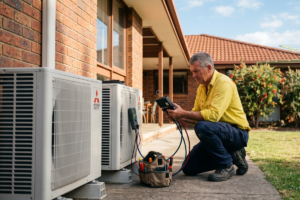
When one of our technicians attends a Brisbane breakdown, the goal is a straight answer you can act on. We diagnose the fault on-site, explain what is wrong in plain terms, and give you the repair cost against a realistic replacement cost so you can see the 50% rule for yourself.
If the repair makes sense, we carry major spare parts and can often fix it on the same visit. If your unit is genuinely past it, we will say so, with no pressure either way. And if you decide on a new system installation, the initial booking fee is credited toward the cost of the new unit, so you are not paying twice for the assessment.
Every QuickAir service is a fixed, published price with no call-out fees, and our 350-plus licensed and insured technicians cover Brisbane and surrounding suburbs with same-day or next-morning availability in most cases. The price you see is the price you pay.
Frequently asked questions
How much does air conditioner repair cost in Brisbane?
Minor repairs such as a thermostat, capacitor or fan fix typically run $70 to $250. A refrigerant leak repair or regas can range from around $160 to $1,600, and a major mechanical fault like a compressor usually costs $1,000 to $1,600.
How long do air conditioners last in Australia?
Most split-system air conditioners last around 10 to 15 years with regular servicing. After that, efficiency declines, warranties expire, and replacement parts become harder to source.
Should I repair or replace a 10-year-old air conditioner?
It depends on the fault. A minor repair on a 10-year-old unit that has been well maintained is usually worth it. If the repair is a major one, or it costs more than half the price of a new unit, replacement is generally the better value at that age.
Is R-22 air conditioning gas still available in Australia?
Yes, for now. R-22 can still be used to service existing equipment, but bulk imports will be banned from 1 January 2030, after which servicing relies on reclaimed gas. Supplies are already tighter, which makes R-22 repairs more expensive.
Does a new unit really save money on power bills?
Generally, yes. Newer reverse-cycle systems are roughly 20 to 30 percent more efficient than decade-old models, and heating and cooling make up around 40 percent of household energy use, so the savings add up over Brisbane’s long cooling season.
Get an honest answer for your unit
If your air conditioner has broken down and you are not sure whether to fix it or replace it, the fastest way to know is to have it properly diagnosed. Book a repair assessment with QuickAir and we will give you the repair cost, a replacement cost if it is warranted, and a straight recommendation, so you can make the call with the real numbers in front of you.
Ready when you are
Book a licensed technician — same-day, every capital city.
$239 call-out inc GST · fixed price, no surprises · 4.9★ (128 Google reviews)